
Where You Age Matters: Economic Security Across States
October 16, 2026


Economic security in later life depends on both household income and the costs of meeting basic needs where people live. In other words, older adults (age 65+) may have similar retirement incomes, yet face very different costs for meeting their basic needs. The Elder Index makes those differences visible by estimating the income required to cover essential expenses by county. The Elder Index measures the necessary living expenses that older adults need—including housing, health care, food, and transportation—based on where they live. These geographic differences are fundamental to understanding whether older adults can remain independent and connected to their communities. For older adults whose incomes are above the Federal Poverty threshold but below the Elder Index values are considered to be living “in the gap”. They are unable to afford basic needs despite not being officially considered poor.
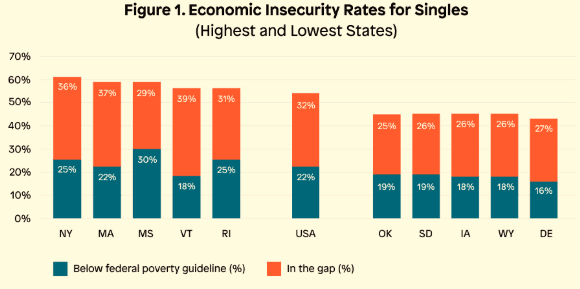
Figure 1 shows substantial differences across states in both the extent of economic insecurity and how much of it is captured by the federal poverty guideline. Nationally, 22% of the population represented falls below the poverty guideline, while another 32% lives “in the gap”—with income above the poverty guideline but below the Elder Index’s estimate of basic living costs. Together, more than half of older adults -- 54% -- lack sufficient income to meet basic expenses.
Among the states shown, New York has the highest combined share experiencing economic insecurity, at 61%, followed by Massachusetts and Mississippi at 59%, Vermont at 57%, and Rhode Island at 56%. However, the composition differs. Mississippi has the largest share below the poverty guideline, at 30%, while Vermont has the largest share in the gap, at 39%. Massachusetts also has a substantial gap population, at 37%, despite matching the national poverty figure of 22%. This is worth noting because the poverty figure alone conceals the extent of economic security in a place like Massachusetts.
The lower percentages in Delaware, Oklahoma, Iowa, Wyoming, and South Dakota still represent considerable economic insecurity: their combined shares range from 43% to 45%. Across every state listed, more people live in the gap than below the poverty guideline, except for Mississippi.
These differences are even more stark when examined at the county level . For example, for a single renter in good health, annual basic expenses (e.g., housing and utilities, food prepared at home, transportation, health insurance premiums and out-of-pocket medical costs, and other essentials such as clothing, household supplies, personal care items, and telephone service) range from $23,628 in Walker County, Alabama, to $56,820 in Santa Cruz County, California. That is a difference of more than $33,000 annually. An older adult in Santa Cruz needs approximately 2.4 times as much income to meet the same categories of basic needs. These are budgets for necessities, without a cushion for major emergencies or discretionary spending.
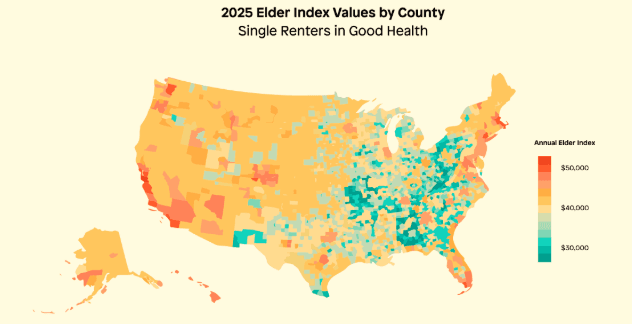
The geographic concentration is striking. Seven of the ten highest-cost counties are in California, alongside Nantucket County, Massachusetts, and Westchester and Rockland counties in New York. The lowest-cost counties are concentrated in Alabama, Missouri, and West Virginia. The purchasing power of retirement income varies considerably across communities.
However, lower costs should not be interpreted as evidence that older residents are financially secure. Economic security reflects the relationship between income and expenses. Even a comparatively modest basic-needs budget can be unaffordable for someone with limited retirement income. The state findings illustrate this distinction: Mississippi has a larger share below the federal poverty guideline than Massachusetts, while Massachusetts has a larger share living “in the gap.” Economic insecurity can arise through different combinations of low income and high costs.
Political context matters because economic security is shaped by public choices as well as personal resources. What do we invest in? Who qualifies for help? Do we recognize need only below the poverty guideline, or also when someone’s income cannot cover local living costs?
In Massachusetts, the large population living in the gap raises questions about affordability and whether assistance reaches people whose incomes look adequate on paper. In Mississippi, the larger population below the poverty guideline underscores the importance of adequate income and accessible supports. Both states need to address both income and costs, although the emphasis may differ.
For communities, they invite a practical question: can residents afford to grow older here? Relocation may reduce expenses, but it can also disrupt relationships, familiar services, and a sense of belonging. We should be working toward communities where remaining connected does not require sacrificing financial security. Aging well requires both adequate personal resources and local conditions that make everyday life affordable.
Acknowledgements
We are grateful for the partnership of the West Health Institute, The Silver Century Foundation, The Henry and Marilyn Taub Foundation, RRF Foundation for Aging, and the National Council on Aging. We are also grateful to Yang Li for his collaboration on the Elder Index and earlier publications and reports on the adequacy of Social Security.
About the Elder Index
The Elder IndexTM is a one-of-a-kind, county-by-county measure of the income needed by older adults to maintain independence and meet their daily living costs while staying in their own homes. Developed by the Gerontology Institute at the University of Massachusetts Boston in collaboration with a national Advisory Board, the Elder Index defines financial security as the income level at which older people can cover basic and necessary living expenses and stay in their homes, without relying on means-tested income support programs, loans or gifts. The Congressional Budget Office (2017) cites the Elder Index as the only retirement adequacy measure that is oriented specifically to older people and takes into account the unique demands of housing and medical care on older people’s budgets.
Elder Index and Elder Economic Security Standard Index are service marks of the University of Massachusetts.
For more information about the Elder Index, including county-level Elder Index values for renters and homeowners, and values for older adults in poor or in excellent health, see ElderIndex.org , Center for Social and Demographic Research on Aging , or contact us at CSDRA@umb.edu .