
The Gender Gap in Aging: Economic Security in 2025
September 22, 2026


Life-long patterns of inequality in work experiences and wealth accumulation contribute to substantial gender disparities in retirement security. These factors reduce women’s earnings and their capacity to accumulate retirement resources. Women also typically outlive men, increasing the likelihood of becoming widowed and living alone and stretching already limited resources across a longer retirement.
Using the 2025 Elder Index™, which estimates the income older adults need to meet basic living expenses such as housing, food, transportation, healthcare, and other necessities, this analysis examines gender differences in economic security among adults aged 65 and older. Economic insecurity is assessed by comparing household incomes to the Elder Index and the Federal Poverty Level (FPL), identifying those below the Elder Index, those below the FPL, and those “in the gap,” whose incomes exceed the FPL but remain insufficient to cover basic needs. The analysis uses state-level data for single women, single men, and older couples, with additional breakdowns by age group.
Half of Older Women Living Alone Are Economically Insecure
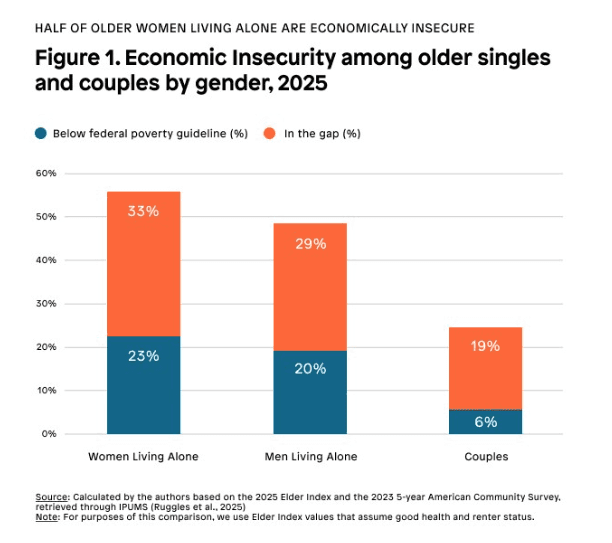
Nationally, 53% of older women living alone have incomes that fall below the Elder Index, compared to 44% of older men living alone and 25% of older couples (Figure 1). Of those below the Elder Index, 23% of single women and 20% of single men also fall below the FPL. One in three single women (33%) and nearly one in three single men (29%) fall “in the gap,” making them ineligible for many needs-based programs while still unable to achieve economic security.
Gender Gaps Widen with Age
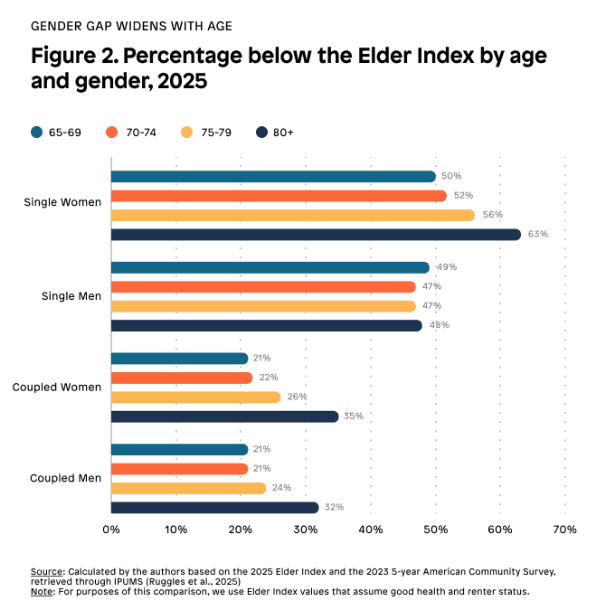
Although economic insecurity affects older single women at every age, the gender gap grows considerably among the oldest adults (Figure 2). Among singles aged 65-69, women and men face nearly identical insecurity rates, about 50%. By ages 75-79, 56% of women but only 47% of men fall below the Elder Index. Among those aged 80 and older, the gap reaches 14 percentage points: 63% of single women versus 48% of single men. The rates for single men remain relatively stable across all age groups (47%-49%), while economic insecurity increases steadily for single women, reflecting the compounding disadvantages of lower lifetime earnings, smaller Social Security benefits, asset depletion over a longer retirement, and a higher likelihood of living alone in older age. For older couples, gender disparities are less pronounced, but economic insecurity continues to rise with age, and the protective effect of coupling is somewhat smaller for women than for men.
Economic Insecurity Varies Considerably Across States
The share of single older women with incomes below the Elder Index ranges from 45% in Oklahoma to 64% in New York, compared to single men, whose rates range from 36% in Wyoming to 55% in New York. In addition to between-state differences, the within-state gender gap is notable. Nationally, women’s insecurity rate exceeds men’s by 8 percentage points. The gap is widest in Wyoming (12 points), Alabama (11 points), and New Hampshire (11 points). In every state, the share of single women who are economically insecure is higher than the share of single men. The Elder Index highlights gaps that traditional poverty measures overlook, underscoring the need for policies that address both life-course inequalities and the financial challenges of aging, particularly for those living alone.
Acknowledgements
We are grateful for the partnership of the West Health Institute, The Silver Century Foundation, The Henry and Marilyn Taub Foundation, RRF Foundation for Aging, and the National Council on Aging. We are also grateful to Yang Li for his collaboration on the Elder Index and earlier reports on the adequacy of Social Security.
About the Elder Index
The Elder IndexTM is a one-of-a-kind, county-by-county measure of the income needed by older adults to maintain independence and meet their daily living costs while staying in their own homes. Developed by the Gerontology Institute at the University of Massachusetts Boston in collaboration with a national Advisory Board, the Elder Index defines financial security as the income level at which older people can cover basic and necessary living expenses and stay in their homes, without relying on means-tested income support programs, loans or gifts. The Congressional Budget Office (2017) cites the Elder Index as the only retirement adequacy measure that is oriented specifically to older people and takes into account the unique demands of housing and medical care on older people’s budgets. Elder Index and Elder Economic Security Standard Index are service marks of the University of Massachusetts.
For more information about the Elder Index, including county-level Elder Index values for renters and homeowners, and values for older adults in poor or in excellent health, see ElderIndex.org , Center for Social and Demographic Research on Aging , or contact us at CSDRA@umb.edu .