
National Aging Readiness
View all in National Aging Readiness Topic
Housing Solutions for an Aging America
As America’s aging population continues to grow, the supply of affordable and accessible housing has not kept up, leading to a shortage of stable housing options for older adults. Adults age 50+ are the fastest growing segment of the U.S. population experiencing homelessness, and the number of homeless older adults is expected to triple by 2030. This presents an urgent need for housing solutions t...
Multisector Plans for Aging: 14 U.S. States Leading the Way on Aging
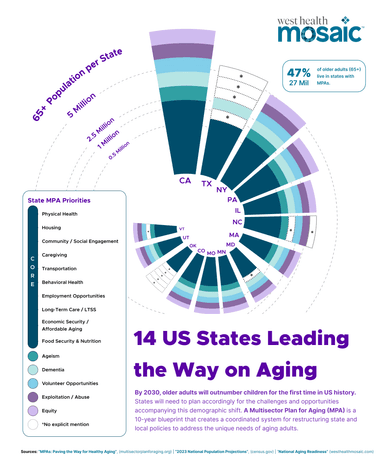
Key Takeaways:To date, 14 states have adopted Multisector Plans for Aging (MPAs)—comprehensive 10-year blueprints that coordinate policies across health, housing, transportation, community engagement, and other areas essential to aging well.These forward-looking plans help states strengthen the systems older adults rely on and tap into the contributions older adults bring to their communities.Toge...
National Aging Readiness Dashboard
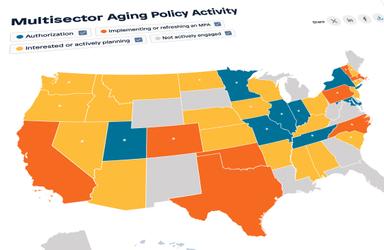
As America's population ages, we face unprecedented challenges and opportunities. Explore America's aging landscape through this interactive eldery care data dashboard, filter demographics, analyze trends across life stages, and uncover insights that challenge assumptions about growing older in the United States.
Leveraging Disability Partnerships and Policies to Advance Age-friendly Ecosystems
AbstractThe success of Age-Friendly Ecosystems depends upon the participation and buy-in of sectors and stakeholders that serve and affect older adults. The disability community is a critical partner that largely has not, to date, been included in age-friendly efforts. The significant percentage of older adults aging with and into disability, the intersections between ageism and ableism, and the c...
Preparing for the Future: Using Data to Support Aging in America
It’s no secret that communities worldwide are experiencing a demographic shift, with older adults soon outnumbering younger generations. In the U.S., the Census Bureau projects that by 2034, adults ages 65 and older will outnumber children younger than 18 for the first time in history.West Health has worked with federal and state agencies to facilitate aging-focused planning, and a common challeng...
Creating the Strategic Framework for a National Plan on Aging
Aging in America and the Case for a National Plan on AgingThere are more than 77 million adults ages 60 and older living in the United States, representing more than 23% of its total population, and this cohort is expected to continue growing rapidly in the coming years. In addition, more people are aging with a disability. Our changing demographics require all levels of government, along with key...
Why MPAs Are Critical to Equitably Meeting the Needs of Aging Communities
In the aftermath of the COVID-19 pandemic, states have an opportunity to rebuild their systems serving elders to better serve all older adults and people with disabilities. This massive feat must begin with a plan.Multisector Plans for Aging—also known as master plans, strategic plans or aging-well plans—offer a powerful tool for communities to better meet older adults’ long-term services and supp...
Mapping America's Aging Future: What the National Aging Readiness Dashboard Reveals
New West Health Mosaic data tool maps the state of aging in America — showing who's ready and where we need to catch up. A demographic shift unlike any in our history is unfolding across America. By 2034, adults 65 and older will outnumber children under 18 for the first time ever. This isn't just a statistical curiosity — it's a transformation that touches everything from healthcare to housing to...
New Federal Rules on SNAP and Medicaid Put Older Adults at Risk
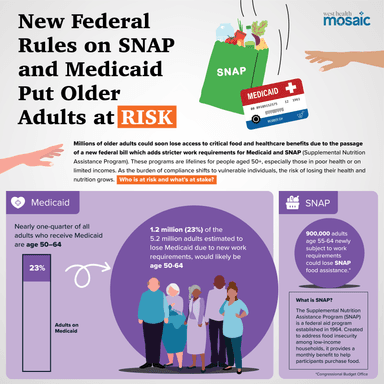
In the infographics below, we highlight who is most affected by the new federal rules, what’s at stake for older adults, and how changes to SNAP and Medicaid could deepen financial hardship and food insecurity for millions nationwide.Key Takeaways:Despite widespread concern about rising costs of food and healthcare, new federal rules put millions at risk of losing essential support.87% of adults a...
America: An Aging Nation
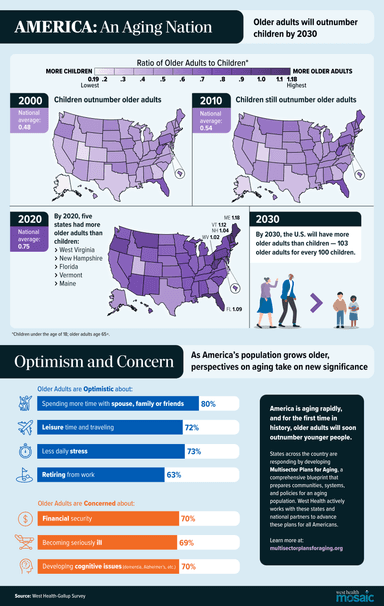
The infographic below illustrates how quickly the nation’s age balance is changing — and how that change is already playing out across states. It also pairs demographic projections with survey data capturing how older adults themselves feel about aging. Together, these insights highlight both the scale of the transition and the lived experience behind the numbers.Key TakeawaysBy 2030, older adults...