
Healthcare Policy
Discover how public health policies shape the future of aging.
View all in Healthcare Policy Topic
What Is Medicaid? A Guide to Qualifications, What It Covers, & Costs
Key Takeaways: Medicaid covers 74M+ Americans, 41% of U.S. births, and 5 in 8 nursing home residents, making it the largest health insurer in the U.S. Eligibility combines federal rules with state variation; expansion states cover adults up to 138% of the federal poverty level. Mandatory benefits include hospital care, physician services, and nursing facility care; dental, vision, and prescription...
Prescription Drug Costs: Plans, Coverage, & Other Price-Driving Factors
Key Takeaways: U.S. prescription drug spending hit $805.9 billion in 2024, with prices averaging 2.78x higher than 33 other OECD nations. High costs stem from manufacturer pricing power, patent thickets, opaque PBM rebates, and insurance cost-sharing tied to list prices. The IRA capped Medicare Part D out-of-pocket costs at $2,100 in 2026 and enabled the first round of Medicare drug price negotiat...
Multisector Plans for Aging: 14 U.S. States Leading the Way on Aging
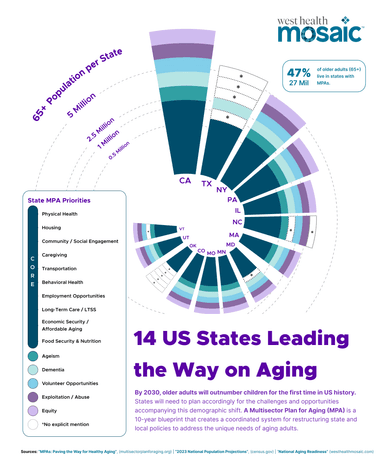
Key Takeaways:To date, 14 states have adopted Multisector Plans for Aging (MPAs)—comprehensive 10-year blueprints that coordinate policies across health, housing, transportation, community engagement, and other areas essential to aging well.These forward-looking plans help states strengthen the systems older adults rely on and tap into the contributions older adults bring to their communities.Toge...
How H.R. 1, The One Big Beautiful Bill Act, Reshapes Healthcare for Older Adults
H.R. 1, or the One Big Beautiful Bill Act (OBBBA) was signed into law on July 4, 2025. The legislation introduced wide-ranging reforms across Medicaid and Medicare, with significant implications for how states finance and deliver care to older adults. In addition, OBBBA includes changes to social services, such as the Supplemental Nutrition Assistance Program (SNAP), and provides funding for trans...
Medicare 101: What Does It Cover & How Much Does It Cost?
Key Takeaways: Medicare has four parts: Part A covers hospital and inpatient care, Part B covers doctor visits and outpatient services, Part C (Medicare Advantage) bundles A and B through private insurers, and Part D covers prescription drugs. Eligibility comes through three main paths: turning 65 with a 10-year work history, receiving SSDI for 24 months, or a qualifying diagnosis of ESRD or ALS. ...
American Exceptionalism

Americans pay substantially more for prescription drugs than people in other high-income countries, often three to four times as much, even though they use fewer medications and have worse overall health outcomes. This gap has been known for decades, but policy efforts have not significantly reduced prices. The problem is rooted in the structure of the U.S. healthcare system rather than difference...
Untapped Potential: The Older Workforce in America
The United States is undergoing a major demographic shift. By 2034 older adults are projected to outnumber children for the first time in the nation’s history. Falling birth rates coupled with longer life expectancies are driving this shift, with significant implications for families, communities, public programs, and the economy. Older adults can play a role in strengthening the U.S. workforce th...
Leveraging Multisector Plans for Aging to Promote Health Equity
As our population skews older, ensuring equitable access to healthcare and social services becomes increasingly important. Multisector Plans for Aging (MPAs) have emerged as a pivotal framework for addressing the diverse needs of older adults and promoting health equity. This comprehensive strategy encompasses initiatives aimed at enhancing well-being and quality of life for older Americans, while...
Creating the Strategic Framework for a National Plan on Aging
Aging in America and the Case for a National Plan on AgingThere are more than 77 million adults ages 60 and older living in the United States, representing more than 23% of its total population, and this cohort is expected to continue growing rapidly in the coming years. In addition, more people are aging with a disability. Our changing demographics require all levels of government, along with key...
Why MPAs Are Critical to Equitably Meeting the Needs of Aging Communities
In the aftermath of the COVID-19 pandemic, states have an opportunity to rebuild their systems serving elders to better serve all older adults and people with disabilities. This massive feat must begin with a plan.Multisector Plans for Aging—also known as master plans, strategic plans or aging-well plans—offer a powerful tool for communities to better meet older adults’ long-term services and supp...