
Healthcare Accessibility
View all in Healthcare Accessibility Topic
What Is Medicaid? A Guide to Qualifications, What It Covers, & Costs
Key Takeaways: Medicaid covers 74M+ Americans, 41% of U.S. births, and 5 in 8 nursing home residents, making it the largest health insurer in the U.S. Eligibility combines federal rules with state variation; expansion states cover adults up to 138% of the federal poverty level. Mandatory benefits include hospital care, physician services, and nursing facility care; dental, vision, and prescription...
Prescription Drug Costs: Plans, Coverage, & Other Price-Driving Factors
Key Takeaways: U.S. prescription drug spending hit $805.9 billion in 2024, with prices averaging 2.78x higher than 33 other OECD nations. High costs stem from manufacturer pricing power, patent thickets, opaque PBM rebates, and insurance cost-sharing tied to list prices. The IRA capped Medicare Part D out-of-pocket costs at $2,100 in 2026 and enabled the first round of Medicare drug price negotiat...
77% of Older Adults Want to “Age in Place” - Housing, Health Care, and Transportation
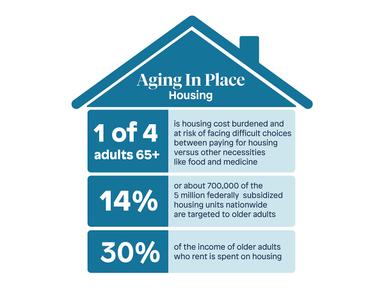
If there is one thing Americans can agree on, it’s that they do not want to end their life living in a nursing home. In fact, about 77% of older adults say that they want to “age in place,” remaining in their communities surrounded by the places, people, and things they love. For some this means continuing to live in their current home. For others this might include living in the home of a relati...
How H.R. 1, The One Big Beautiful Bill Act, Reshapes Healthcare for Older Adults
H.R. 1, or the One Big Beautiful Bill Act (OBBBA) was signed into law on July 4, 2025. The legislation introduced wide-ranging reforms across Medicaid and Medicare, with significant implications for how states finance and deliver care to older adults. In addition, OBBBA includes changes to social services, such as the Supplemental Nutrition Assistance Program (SNAP), and provides funding for trans...
The Growing Challenge of Food Insecurity for Seniors in the U.S.
Food insecurity is a problem that impacts Americans young and old. In 2023, nearly 13% of adults age 50 to 59 and more than 9% of adults age 60 and older experienced food insecurity — an increase from prior years. The U.S. Department of Agriculture (USDA) groups food insecurity into two categories: (1) low food security, defined as reduced quality, variety, or desirability of food, with little or...
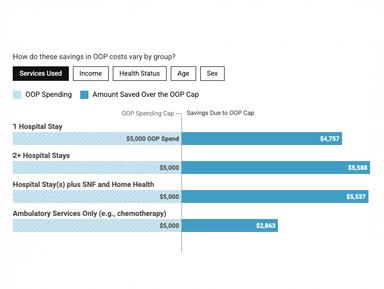
Hardwiring Best Practices for Safe Mobility and Delirium Prevention in Older Adult Patients

IntroductionThis case study, featuring the University of Alabama Birmingham Hospital, underscores how deliberate system redesign can embed evidence-based mobility and delirium prevention strategies into routine care. This approach improves outcomes for older adults — reducing complications, length of stay, and post-acute care needs — and offers a scalable model to transform front-line workflows ac...
2025 Healthcare in America Report
Healthcare is becoming increasingly unaffordable for millions of Americans. The 2025 West Health-Gallup Healthcare Affordability Index reveals a troubling new high: 35% of U.S. adults—an estimated 91 million people—say they could not access quality care if they needed it today. The gap is especially wide among Black, Hispanic, and lower-income Americans, with affordability worsening year over year...
Hope Starts Here: Addressing Suicide Through Access
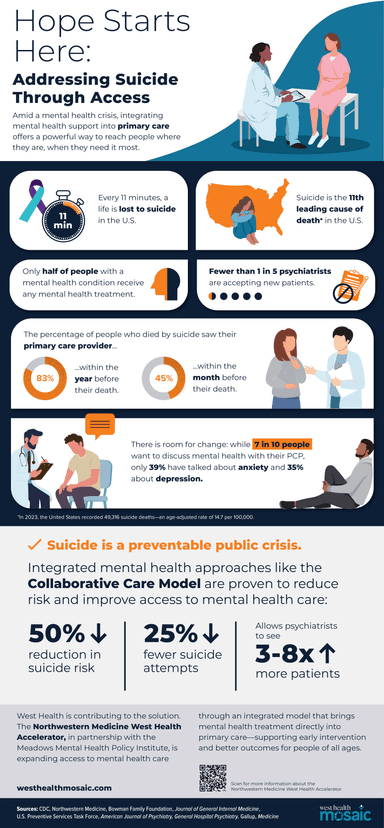
The infographic below tells the story of where change is possible. Primary care is already the place Americans turn to and trust. The Collaborative Care Model builds on that trust, weaving mental health support into the visits people are already making. It's not a new system to navigate or another referral to follow up on. It's care that meets people in a familiar place, at the right moment, befor...
Unmet Needs of Older Adults with Military-Based Healthcare Coverage
IntroductionThe veteran population is aging rapidly with higher rates of disability compared to non-veterans. The number of veterans age 85 and older is projected to increase by 38% from FY2019 to FY2039, and over 40% of veterans age 65 and older have at least one disability compared to 32% of their non-veteran peers. A large percentage of older adults over 50 have healthcare coverage through a m...