
indicator
Income & Poverty
Income & Poverty

Description
Share of Householders Age 65 or Older With Income Below the Federal Poverty Level (FPL) or the Elder Index in Their Area, by Household Size and Housing Tenure, 2022
Data Source
American Community Survey (ACS)
Data Source
Elder Economic Security Standard Index (Elder Index)
Calculation Methodology
- 1Select data from the dataset using the columns
HHLDRAGEP,NP,TENURE, andFPL. - 2Derive age groups from
HHLDRAGEPby binning values into 65-80 forHHLDRAGEPbetween 0 and 64.99, and 81+ for values above 65. - 3Derive household size categories from
NPwhereNP=1means one-person household,NP=2means two persons, andNP=3+means three or more persons. - 4Filter data by
TENUREto separate housing tenure into Owned with mortgage (TENURE=1), Home Owned Without Mortgage (TENURE=2), and Rented (TENURE=3). - 5Apply the weight column
WEIGHTto calculate weighted shares of householders aged 65 or older with income below the Federal Poverty Level (FPL). - 6Aggregate the weighted results by
NPcategories andTENUREgroups to produce the grouped stacked bar chart by household size and housing tenure.
Source Variables using this Indicator (13)
Visuals Using This Indicator (1)
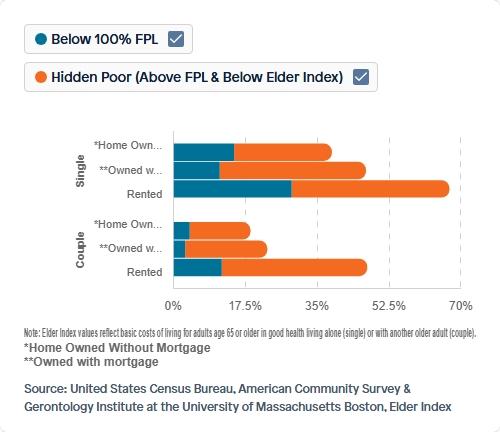
Share of Householders Age 65 or Older With Income Below the Federal Poverty Level (FPL) or the Elder Index in Their Area, by Household Size and Housing Tenure, 2022
View visualizationWhy This Matters
Transparent methodology ensures every insight can be traced, verified, and built upon.
Reproducible Research
Every calculation can be traced back to its source. Our methodology documentation enables researchers to replicate findings and build upon our work.
Accountability
Clear attribution and citation requirements ensure proper credit to data providers and maintain research integrity.
Continuous Improvement
Transparent documentation allows for peer review, feedback, and iterative improvements to our analytical approaches.