
indicator
Disability
Disability

Description
Share of Population Age 60 or Older Reporting Difficulty Dressing or Bathing (Self-Care Difficulty) and/or Difficulty Doing Errands Alone (Independent Living Difficulty) Because of a Physical, Mental, or Emotional Condition, by Age, 2023
Data Source
American Community Survey (ACS)
Calculation Methodology
- 1Select records from the dataset where
AGEPis 60 or older. - 2Derive age groups from
AGEPas follows: 60-69 (AGEP≥ 60 and < 70), 70-79 (AGEP≥ 70 and < 80), and 80+ (AGEP≥ 80). - 3Identify disability status using the columns
DDRSandDOUT, where combinations of these indicate difficulty dressing or bathing and/or difficulty doing errands alone. - 4Apply the weight column
PWGTPto each record to account for survey sampling design. - 5Aggregate weighted counts by
STATEand by the derived age groups to calculate the share of the population reporting disability. - 6Present the results as a stacked bar chart showing disability shares by age groups 60-69, 70-79, 80+, and totals for ages 60+ and 65+.
Source Variables using this Indicator (18)
Visuals Using This Indicator (1)
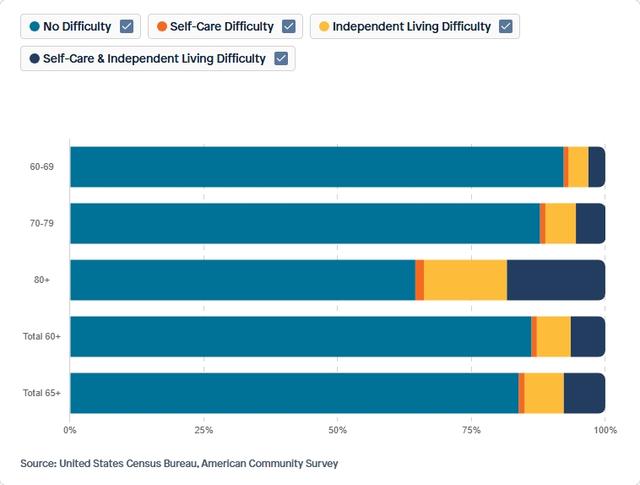
Share of Population Age 60 or Older Reporting Difficulty Dressing or Bathing (Self-Care Difficulty) and/or Difficulty Doing Errands Alone (Independent Living Difficulty) Because of a Physical, Mental, or Emotional Condition, by Age, 2023
View visualizationWhy This Matters
Transparent methodology ensures every insight can be traced, verified, and built upon.
Reproducible Research
Every calculation can be traced back to its source. Our methodology documentation enables researchers to replicate findings and build upon our work.
Accountability
Clear attribution and citation requirements ensure proper credit to data providers and maintain research integrity.
Continuous Improvement
Transparent documentation allows for peer review, feedback, and iterative improvements to our analytical approaches.