
Owned, Owed, or Rented: How Housing Shapes Retirement Security
September 28, 2026


Housing is often treated as a backdrop to retirement, but it is one of the strongest determinants of whether older adults can meet their basic needs. The Elder Index measures the income older adults require to live independently with dignity, accounting for essential expenses such as housing, healthcare, food, transportation, and other necessities. Unlike the federal poverty guideline, it reflects the actual cost of living in later life. The figures show that retirement security depends not simply on whether someone owns a home, but on whether that home is fully owned, still carries debt, or is rented.
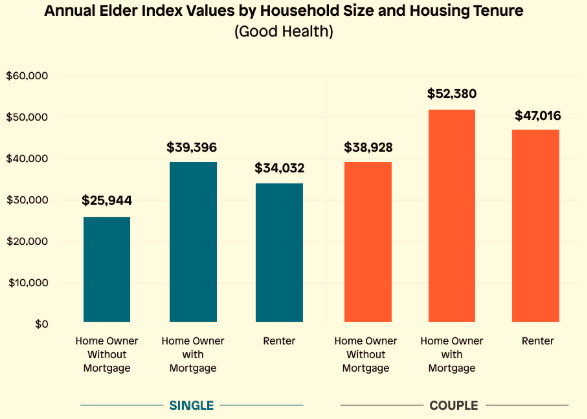
Figure 1 illustrates how sharply the income needed for basic economic security varies by housing tenure. A single older homeowner without a mortgage needs $25,944 annually, compared with $39,396 for an owner with a mortgage and $34,032 for a renter. For an older couple, the same pattern persists: the annual Elder Index rises from $38,928 for homeowners without a mortgage to $52,380 for those with a mortgage and $47,016 for renters. In both household types, carrying a mortgage produces the highest annual income requirement. The difference is substantial: a mortgage adds $13,452 to the annual budget of both a single homeowner and a couple, relative to owning a home outright.
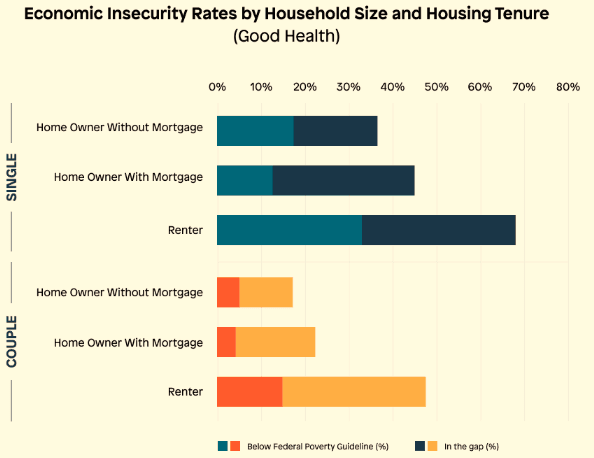
Yet required income is only part of the story. Figure 2 shows how many older households lack the resources needed to reach these thresholds. The blue portion represents households below the federal poverty guideline, while the rust-colored portion captures those who live above the poverty line but below the Elder Index—the “gap” in which income is too high to be classified as poor but still insufficient to cover basic expenses.
Renters face the greatest insecurity. Among single renters, 33% fall below the federal poverty guideline and another 35% are in the gap, meaning 68% have incomes below the Elder Index. Among renter couples, 15% are below poverty and 33% are in the gap, for a combined 48%. Homeownership without a mortgage offers the strongest protection, but it does not guarantee security: 36% of single mortgage-free homeowners and 17% of mortgage-free couples still fall below the Elder Index. For homeowners with mortgages, the combined rates are 45% for singles and 22% for couples.
Together, the figures reveal why conventional measures can understate economic hardship among older adults. Many households who are not officially poor still cannot afford a basic budget, and housing status changes both the amount they need and their likelihood of falling short. For policymakers, researchers, and health-sector leaders, the implication is clear: strategies to improve retirement security must extend beyond income support alone. They should also address rental affordability, mortgage burdens, property taxes, utilities, home maintenance, and access to housing assistance. Housing is not merely an asset or an expense; it is a central pathway through which financial stability, health, and the ability to age independently are shaped.
Acknowledgements
We are grateful for the partnership of the West Health Institute, The Silver Century Foundation, The Henry and Marilyn Taub Foundation, RRF Foundation for Aging, and the National Council on Aging. We are also grateful to Yang Li for his collaboration on the Elder Index and earlier publications and reports on the adequacy of Social Security.
About the Elder Index
The Elder IndexTM is a one-of-a-kind, county-by-county measure of the income needed by older adults to maintain independence and meet their daily living costs while staying in their own homes. Developed by the Gerontology Institute at the University of Massachusetts Boston in collaboration with a national Advisory Board, the Elder Index defines financial security as the income level at which older people can cover basic and necessary living expenses and stay in their homes, without relying on means-tested income support programs, loans or gifts. The Congressional Budget Office (2017) cites the Elder Index as the only retirement adequacy measure that is oriented specifically to older people and takes into account the unique demands of housing and medical care on older people’s budgets.
Elder Index and Elder Economic Security Standard Index are service marks of the University of Massachusetts.