
Impact of the Inflation Reduction Act on Medicare Beneficiary Affordability and Mortality
August 13, 2026


The Inflation Reduction Act (IRA) introduced multiple reforms to Medicare prescription drug payments, including a redesign of the Part D prescription drug benefit, rebates for drugs with price increases beyond inflation, the ability for Medicare to negotiate the price of certain drugs, and an option to have a predictable monthly payment plan for some beneficiaries. These changes are intended to improve the affordability of prescription drugs for Medicare beneficiaries.
High out-of-pocket (OOP) drug costs are a well-documented barrier to medication adherence in the United States. Cost-related non-adherence (CRNA) is common in the United States and is associated with adverse health outcomes, including mortality. This issue is of particular concern for those with chronic conditions, who may rely on expensive medications long-term. By reducing OOP costs, the IRA has the potential not only to generate financial savings, but also to improve medication adherence and health outcomes.
While prior studies have examined the effect of some IRA provisions, particularly the Medicare negotiation provision, on federal expenditures and beneficiary affordability, none at the time of writing had analyzed how these provisions may impact medication adherence and health outcomes, such as mortality. In addition, no study has examined potential beneficiary savings across individual IRA provisions.
This report addresses these gaps by exploring the impacts on beneficiary affordability of four IRA provisions and, where possible, downstream health outcomes:
Our estimates suggest that the IRA's drug affordability measures are poised to deliver meaningful benefits to Medicare beneficiaries. We project that the cost-sharing caps could prevent nearly 39,000 deaths annually by reducing cost-related non-adherence among beneficiaries with chronic conditions. In addition, negotiated prices that went into effect in 2026 may reduce annual coinsurance payments for patients using three high-cost specialty drugs by between $2,269 and $4,874. If patient spending followed similar patterns to those in 2023, beneficiaries may be able to pay $1.6 billion in out-of-pocket costs as manageable monthly installments. Meanwhile, Part B inflation rebates reduced coinsurance payments by $2.7 million within the first nine months of implementation.
Our projections align with emerging data showing that OOP reductions from the IRA measurably impact utilization and adherence. As in our analysis, the effect appears to be particularly significant for those who do not qualify for the low-income subsidy. Utilization increases in this group have exceeded expectations, suggesting that poor affordability affects those with higher incomes more than previously understood. Policymakers weighing further reforms should carefully weigh the financial and health consequences of policies that may affect affordability.
Download the full whitepaper to learn more.
Downloads
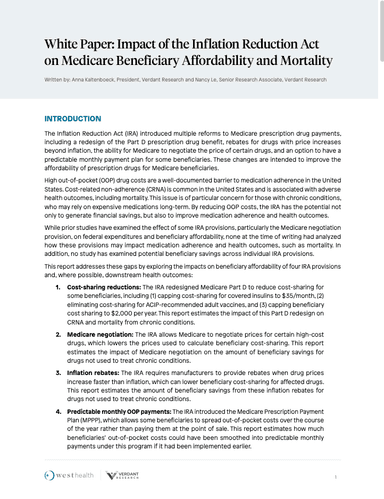
Impact of the Inflation Reduction Act on Medicare Beneficiary Affordability and Mortality
Download