

Significantly improving patient outcomes. That’s the goal of the Collaborative Care Model (CoCM): a patient-centered integrated care approach that leverages task sharing and population health strategies to treat common mental health problems in medical settings. We developed the following fact sheet to inform readers about this evidence-based approach to treating common mental health problems. Read more to understand the basics of CoCM, and how this patient-centered, integrated approach prioritizes accountability and quality and helps to achieve the quadruple aim of healthcare reform.
The Evidence Speaks Volumes: CoCM is Highly Effective
According to our research, CoCM results in positive outcomes across numerous mental health diagnoses and among multiple racial and ethnic groups. It is also successful in different treatment settings – from rural to urban – and presents a financially durable model. Let’s take a closer look at the facts:
“The effectiveness of CoCM is clear: studies show that it reduces racial and ethnic disparities in treatment outcomes and is effective when implemented in rural or under resourced urban treatment settings.”
The Five Core Principles and Goals of CoCM6
The CoCM Care Team
Wherever CoCM is applied, the care team consists of three individuals:
Rather than solely relying on primary care to treat mental health problems, the CoCM adds two additional members to the primary care team: the Behavioral Health Care Manager (BHCM): a licensed or unlicensed mental health provider such as a social worker or lay health worker trained in CoCM, and a Psychiatric Consultant (PC): a psychiatrist or other prescribing mental health clinician.
All three work closely together to ensure that patients with common mental health problems are detected early, referred to CoCM, treated appropriately, and followed closely until their symptoms and functional status improve significantly.
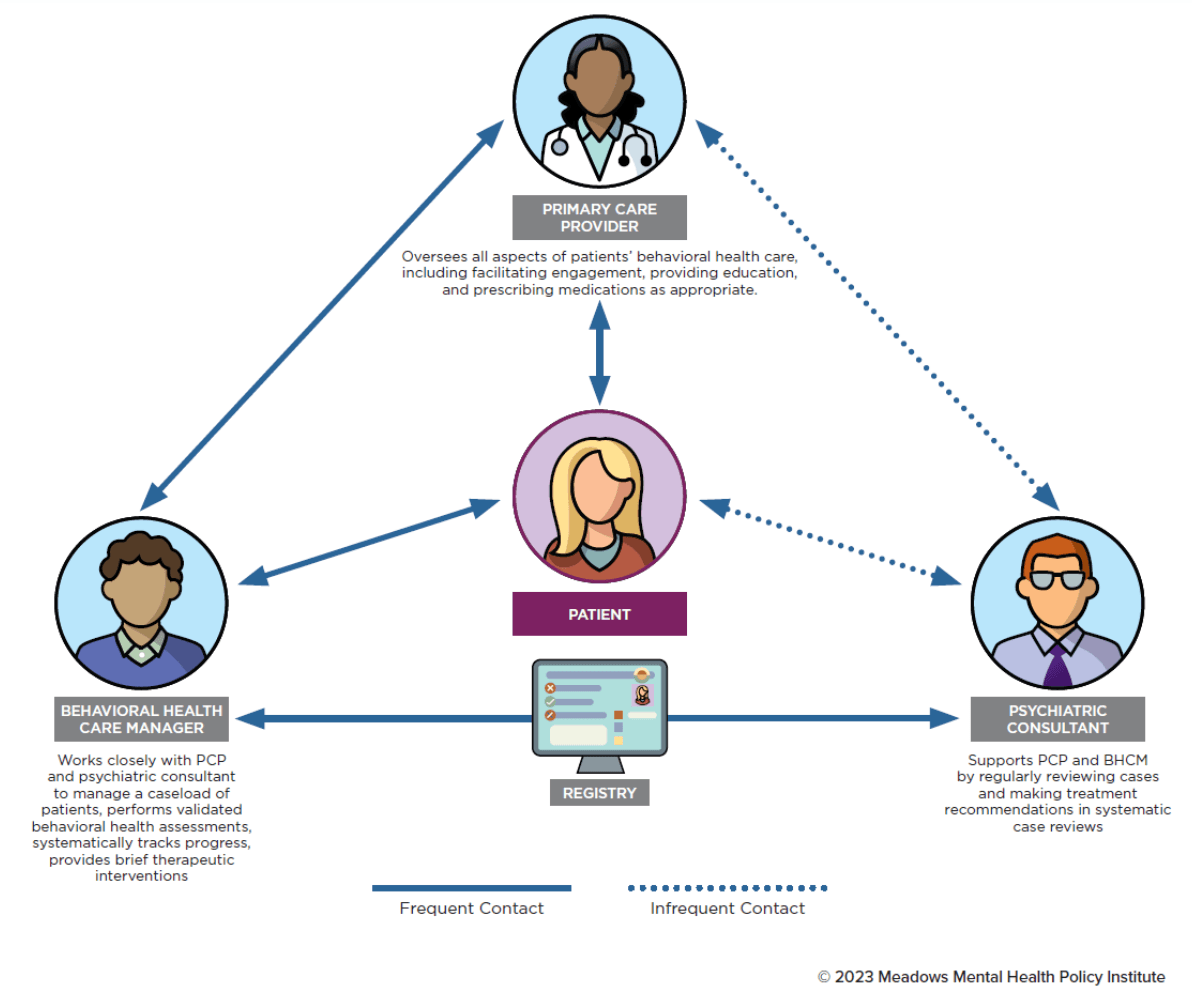
The above illustration outlines the three key CoCM team members, briefly describes their roles, defines the patient-centered nature of the care model, and highlights the importance of the treatment registry. We provide more detailed explanations of the specific team roles and their systematic interactions below.
The Role Each CoCM Team Member Plays
Primary Care Provider (PCP)8
Behavioral Health Care Manager (BHCM)9
Psychiatric Consultant (PC)10
How Does CoCM Operate?
In CoCM, a defined group of referred patients meeting program inclusion and exclusion criteria (most often mild-moderate depression or anxiety) is closely followed through a treatment registry (i.e., clinical tracker). This treatment registry helps the CoCM team measure and track key mental health symptoms over time and ensures that patients are not lost to follow-up.
The PC provides treatment recommendations including medication, when indicated, for the PCP to consider and carry out. The BHCM delivers brief therapeutic interventions (e.g., motivational interviewing, behavioral activation) to help patients with their mental health symptoms.
How Long Does a Patient Typically Receive CoCM?
CoCM treatment episodes last an average of three to six months. During that time, the team will help clarify mental health diagnoses and implement a treatment plan, which often includes medication and brief psychotherapeutic interventions (e.g., motivational interviewing, behavioral activation). Once patients demonstrate symptomatic improvement (as defined by validated measures), the CoCM team develops a Relapse Prevention Plan (RPP). This plan helps the patient maintain their mental health and wellness, while also identifying signs or symptoms that indicate a new episode of care may be needed.
Can a Patient Re-enter CoCM?
After discharge from the CoCM program, a patient can always re-engage with CoCM if needed. In certain cases, when patients are not showing improvement, they may need to receive a higher level of specialty mental health treatment. The CoCM team can help connect that patient with those services as needed.
Reimbursing CoCM through Insurance
CoCM is the only specific, evidence-based integrated mental health model to have designated billing codes. CoCM billing codes are time-based and reported as the total amount of time the BHCM, in collaboration with the PC, working under the direction of the PCP, spends engaging in clinical activities over the course of each calendar month in a treatment episode.11
“CoCM has designated billing codes that are reimbursed by Medicare, most commercial payers, and a growing number of state Medicaid plans, leading the model to be financially sustainable”
Four Key reimbursement Points
How CoCM Helps to Achieve the Quadruple Aim of Healthcare Reform
The result of this integrated approach is that CoCM helps to achieve the quadruple aim of healthcare reform: improved health outcomes, lower healthcare costs, improved patient experience, and improved provider satisfaction.13 Additionally, CoCM extends the clinical impact of prescribing mental health clinicians to as many as eight times the number of patients that they could serve individually.14